CourtListener Just Opened Its Full API to Every Member. Here's the One Question It Still Can't Answer.
A nonprofit built the archive the rest of the legal data industry quietly stands on. It was never built to tell you what a judge will do with your 31st page.
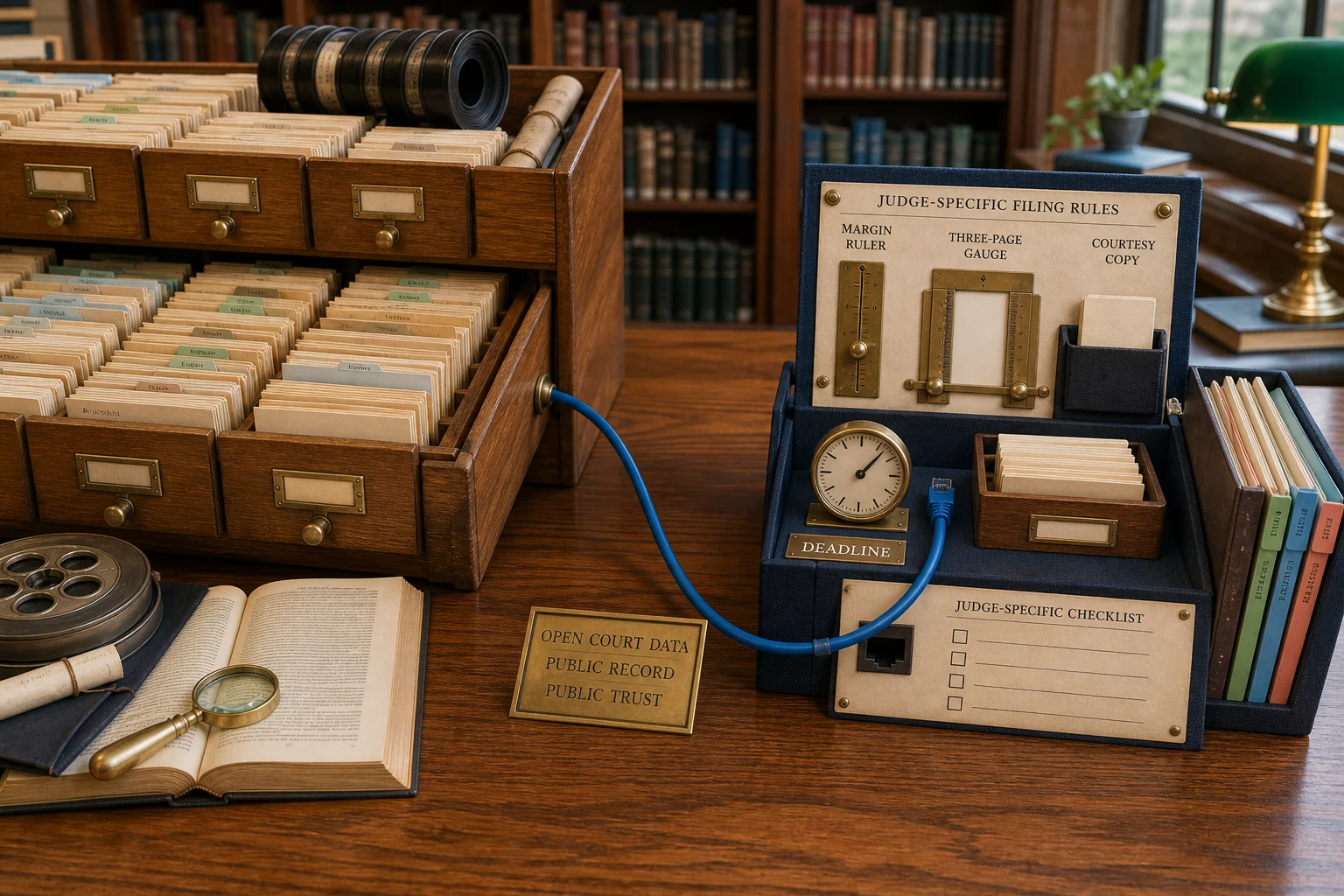
Same judge, same case type, two different questions
Field names simplified for readability. The right-hand rule and citation are real: Judge Amon's Individual Rules, page 2, section 3.
In May 2026, Free Law Project opened full CourtListener API access, including the PACER-derived endpoints, to every member. No more contact form, no more waiting for a partnership review. If you support the nonprofit, you get the keys. That access has been bankrolled by donations and grants for over a decade instead of a Series A.
Free Law Project is a federally recognized 501(c)(3), founded in 2013. RECAP, its browser extension, has spent years quietly pulling documents out of PACER every time a member downloads one and depositing them in a public archive, which is how CourtListener ended up holding something on the order of half a billion PACER-derived items: dockets, entries, documents, parties, attorneys. That archive exists because thousands of people installed a browser extension and let their PACER downloads become public. It's what public infrastructure looks like when the public actually builds it: one PACER download at a time.
What the API actually returns
Case law, going back to 2009. PACER docket data: entries, documents, parties, attorneys. Judge biographical data: political affiliation, education, employment history. Federal and state judicial financial disclosures. The largest public collection of oral argument audio online. Citation lookups and a citation graph. All of it queryable, all of it real, all of it free to a member.
None of it answers this question: what happens if I file 31 pages?
The field that doesn't exist
A docket entry tells you a motion was filed on a given date by a given party. It doesn't tell you the motion was two pages over the limit, because the docket entry schema has no concept of a page limit. That's not a gap in Free Law Project's execution, it's outside the scope of what a docket is. A docket is a record of what happened. It was never a record of what a specific judge requires before you file.
Take Judge Carol Bagley Amon in EDNY, whose individual rules are published, current, and specific about things you did not know could be specified. Her pre-motion letters are capped at 3 pages, with a 7-day response requirement, cited to page 2, section 3 of her Individual Rules. Fax communications to chambers are capped at 10 pages without prior authorization, page 2, section 2, which suggests that at some point someone sent chambers a very long fax. Courtesy copies are required by hand delivery for any ECF filing over 5 pages, page 1, section 1, so the document you filed electronically also makes the trip on foot. Exhibits go in a separate binder, double-sided, with numbered tabs in a specified order, page 3, section D, because the tab order is load-bearing.
None of that lives in a docket. It lives in a standing order PDF that a clerk posted to the court's website, and it changes whenever the judge decides it changes, with no changelog and no warning. There is no PACER event for "judge updated their individual practices." CourtListener wasn't built to catch that, and neither was almost anything else. That's the actual gap, and it isn't any one product's fault.
Different questions, not competing answers
If your product needs to know who's a party to a case, when it was filed, or what a judge has written in a published opinion, CourtListener is exactly the right place to get it. If your product needs to know whether the brief your user just drafted will get rejected by a specific judge's specific formatting rule before they hit file, that's a different question, from a different document, on a different schedule. That second question is what we built Court Rules to answer: standing orders and individual practices for 750+ federal judges across 20 districts, every rule cited to the page and section it came from, the same way the Amon rules are cited above, because "trust us" is not a citation.
Support Free Law Project if you use CourtListener. It's good infrastructure and it's funded the way good public infrastructure should be. Just don't expect a docket entry to tell you your margins are wrong.