We Now Cover One in Ten U.S. Counties
The fax page limit doubles when you cross one county line in Ohio, and the least populous county in the country has exactly one standing order. The examples below come from the 350 counties now on the site.
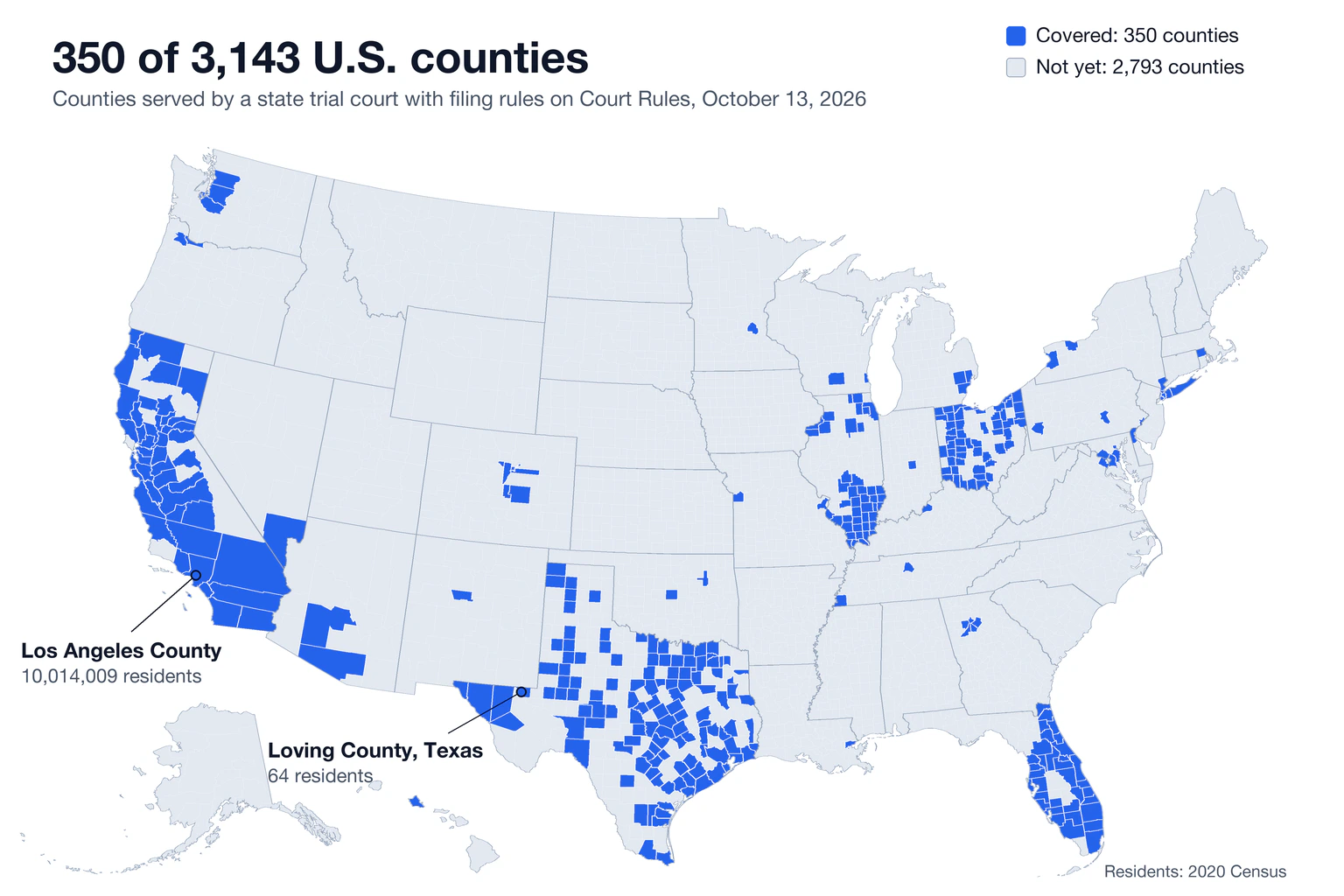
Court Rules now has the filing rules of a state trial court in 350 U.S. counties, which is one county in every ten. Nearly half the country's residents live in those counties.
A statewide rule is the same in every county of a state. The rules below each come from one county's court or one judge, so they can change when you file in the next county.
The largest county and the smallest
Los Angeles County has 10 million residents, more than any other county in the country. Its Superior Court page lists 116 judges and 6,624 filing rules.
Loving County, Texas has 64 residents, fewer than any other county. Its district court has one standing order on file with the state, and the order says who may read the records in child-protection cases. Both courts are on the map above.
What changes when you file one county over
The fax page limit
Ohio's common pleas courts still take filings by fax, and each court sets its own page limit. Here are four counties along Interstate 75, from south to north:
- Miami County allows 10 pages, with the cover page counted
- Shelby County allows 20 pages
- Auglaize County allows 20 pages
- Wood County allows 25 pages by fax, or 25 MB by email
Facsimile filings shall not exceed 10 pages in length including the cover page and all attachments and exhibits. Multiple fax transmissions shall not be used to circumvent this limitation.
A twelve-page motion is within the limit in Shelby County, but in Miami County it's over the limit before the cover page is counted. Hardin County takes fax filings at one number only, and its rule says what happens to a fax sent to any other number.
Facsimiles to any other number will be deemed as not filed with the Clerk of Court.
Federal courts have fax rules of their own, and we listed them in an earlier post.
How long a brief can be
Richland County, Ohio allows 30 pages for a motion or a response and 12 pages for a reply, and its rule says the court may strike a longer one. Boone County, Illinois limits a civil brief to 15 pages unless the court approves more. Judge Laurie E. Buchanan in Florida asks for far less.
BREVITY IS APPRECIATED AND ENCOURAGED, and memorandums should be kept to no more than five (5) pages in length.
Word or PDF for the proposed order
Judge David A. Cromartie of Florida's Seventh Circuit takes proposed orders in Word only.
All proposed orders must be submitted in an up-to-date "WORD" format. PDF orders will not be accepted.
Boone County, Illinois takes a PDF, and the PDF has to be made straight from the word processor.
In the event that proposed orders are submitted in a case, the PDF of the proposed order must be generated directly from a word processing program.
E-filing rules differ in the same way. For example, Mendocino County, California rejects the whole e-filing envelope when one PDF holds more than one document.
What to wear, including on video
Some courts put the dress code in writing. Judge Curt Jacobus of Florida's Eighteenth Circuit gives the wording for a remote hearing notice.
The Judge requires a VIDEO appearance and court attire.
Hardin County, Ohio says what the court may do when a person isn't dressed for court.
Failure to dress appropriately could result in the matter being continued until such person is appropriately attired.
Federal judges write dress codes into their standing orders too, and we collected them in an earlier post.
Where to look before you file in a new county
- The court's local rules. They set filing methods, page limits and formats for the whole court.
- The judge's page or standing order. In larger courts each judge or department adds rules.
- In Texas, the state's local-rules site. A Texas court's local rules, forms and standing orders take effect when they're posted on one website run by the Office of Court Administration, so check that site.
Court Rules puts all three on one page per court and one page per judge. Each rule is shown with the court's own sentence and a link to the document, so you can read the source before you rely on the rule. You can start in the state court directory.
From 4 courts to 326
The first four state courts, in Los Angeles and the Chicago area, went on the site in May. More than 19,000 litigators, paralegals and people who build legal software have used Court Rules since February, and 5,600 of them came in September.
What is still missing
Nine counties in ten aren't covered yet, and 22 states and the District of Columbia have no state trial court on the site. To ask for a court, email us its name and county.
The counts are from October 13, 2026. A county counts when a state trial court that serves the county has at least one rule on the site. Resident counts are from the 2020 Census. The people count is visitors to court, judge and rule pages, with known automated traffic left out. Download the list of courts and counties (CSV).