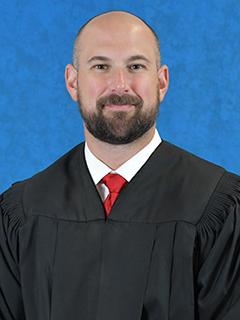
Judge Jeff Martz
Individual Rules, Standing Orders & Policies
- Rules last changed:
Limits & Logistics
Courtesy Copies
All Motions
Courtesy copies
- 1 copy
- Five Days Prior To Hearing
Jury Instructions, Pretrial Order
- 1 copy • Email • No Later Than Noon Friday Prior To Trial Week
E Filed Document
Court-wideAdjournments
- A continuance motion must specifically state the basis and timing of the need, opposition, readiness actions and dates, and the proposed ready date and party agreement.
- Continuance motions are disfavored and may be granted only for good cause.
- Successive continuance requests are highly disfavored.
- +1 more
Request must include
Communication
Chambers
Phone
Chambers
Clerk
Phone
Court-widePhone
Court-wideClerk
Phone
Court-wideDuty Judge
Document Format Requirements3 rules
The agreed verdict forms, pretrial stipulations, and jury instructions must be submitted in Microsoft Word format.
The parties shall communicate and submit one set of agreed verdict forms, pre-trial stipulations, and jury instructions (Times New Roman, 12 pt. font) mailed in WORD format to CAD-DivisionS@pbcgov.org no later than noon on Friday prior to trial week.
DOCX
The preferred file format for submitted orders is Microsoft Word.
The Court prefers all orders to be submitted in WORD format through Online Services with service to opposing counsel and any self-represented litigant.
DOCX
An excused self-represented litigant's proposed order must be submitted in Microsoft Word format.
Self-represented litigants excused from e-mail service may submit proposed orders to the court in WORD format by email to CAD-DivisionS@pbcgov.org, U.S. mail or hand-delivered to the judicial office.
DOCX
Document Filing Requirements6 rules
Every notice of hearing must include the required ADA notification and language confirming counsel's compliance with Local Rule 4.
All notices of hearing must contain the Americans with Disabilities Act (ADA) notification required by Florida Rule of General Practice and Judicial Administration 2.540 and the language that counsel has complied with Local Rule 4 (PDF).
Document Type
Notice Of Hearing
Parties must comply with Local Rule 4 before requesting a hearing.
All parties must comply with Local Rule 4 (PDF) prior to requesting a hearing.
Document Type
Hearing Request
Every proposed order must include a cover letter certifying unanimous agreement or identifying the parties' disagreement.
All proposed orders must be accompanied by a cover letter either (1) certifying that all parties agree to the order or (2) containing a statement identifying any disagreement of the parties as to the proposed order.
Document Type
Proposed Order
A motion is required to request communication technology for an evidentiary hearing or trial-status hearing appearance.
Requests to use communication technology for an appearance any evidentiary hearing or trial status hearing must be made by motion.
Document Type
Motion
An emergency-hearing request must be made by a detailed motion stating the issues, reasons emergency treatment is necessary, and time needed for each party.
If a party believes there is a factual basis for setting an emergency hearing, a detailed motion setting forth the following must be filed: (1) the issues to be resolved, (2) reasons why an emergency hearing is necessary, and (3) the amount of time needed for each party's presentation.
Document Type
Emergency Motion
A remote-appearance notice of hearing must include the Division Zoom link.
A notice of hearing involving any remote appearance must list the Division Zoom link.
Document Type
Notice Of Hearing
Filing & Service rules
Electronic Filing Rules
The court prefers proposed orders to be submitted in Word through Online Services and served on opposing counsel and any self-represented litigant.
The Court prefers all orders to be submitted in WORD format through Online Services with service to opposing counsel and any self-represented litigant.
Page 1 | D. Submission of Orders and Judgments
Self-represented litigants excused from email service may submit proposed orders by email, U.S. mail, or hand delivery.
Self-represented litigants excused from e-mail service may submit proposed orders to the court in WORD format by email to CAD-DivisionS@pbcgov.org, U.S. mail or hand-delivered to the judicial office.
Page 1 | D. Submission of Orders and Judgments
Filing Timing and Cure Windows
All hearing materials, including case law, must be received no later than three business days before the hearing.
The Court must receive all materials for the hearing, including case law, no later than three (3) business days before the hearing.
Page 1 | B. Scheduling Procedures
A notice of hearing must be filed and served immediately after hearing time is reserved.
A notice of hearing must be filed and served immediately after reserving hearing time.
Page 1 | B. Scheduling Procedures
Unless the court states otherwise, proposed orders are due no later than one week after the hearing.
Proposed orders must be submitted no later than one week after any hearing unless otherwise stated by the Court.
Page 1 | D. Submission of Orders and Judgments
Service and Proof of Service Rules
Attorneys and self-represented litigants must use Form 2.603 whenever their registered electronic-service email changes.
It is the responsibility of attorneys and self-represented litigants to update their contact information using Form 2.603, email designation form, any time there is a change in the e-mail account registered for electronic service.
Page 1 | A. Communications with the Judicial Office
Attorneys and self-represented litigants must provide an email address for receipt of signed orders unless excused.
All attorneys and self-represented litigants must provide an e-mail address to receive signed orders electronically, unless excused.
Page 1 | A. Communications with the Judicial Office
The notice of hearing must be served immediately after hearing time is reserved.
A notice of hearing must be filed and served immediately after reserving hearing time.
Page 1 | B. Scheduling Procedures
Attorneys and self-represented litigants generally must make and receive service by email through the Florida Courts E-Filing Portal unless excused.
All attorneys and self-represented litigants must make and receive service by e-mail, which is generally through the Florida Courts E-Filing Portal, unless excused.
Page 1 | A. Communications with the Judicial Office
Submitted orders must be served on opposing counsel and any self-represented litigant.
The Court prefers all orders to be submitted in WORD format through Online Services with service to opposing counsel and any self-represented litigant.
Page 1 | D. Submission of Orders and Judgments
Courtesy Copy Requirements
A courtesy copy of each motion used for a hearing or trial must be emailed to the division account.
Courtesy copies of Motions must be submitted to the Court by email to CAD-DivisionS@pbcgov.org for any hearing or trial.
Page 1 | E. Courtesy Copies of Case Law and Other Documents
The parties must jointly submit agreed verdict forms, pre-trial stipulations, and jury instructions in Word format, using Times New Roman 12 pt. font, by noon on Friday before trial week.
The parties shall communicate and submit one set of agreed verdict forms, pre-trial stipulations, and jury instructions (Times New Roman, 12 pt. font) mailed in WORD format to CAD-DivisionS@pbcgov.org no later than noon on Friday prior to trial week.
Page 1 | E. Courtesy Copies of Case Law and Other Documents
Case law must be submitted five days before the hearing.
Case Law shall be submitted 5 days prior to the hearing, if the Case Law exceeds more than 10-pages, parties shall hand deliver or mail a hard copy.
Page 1 | E. Courtesy Copies of Case Law and Other Documents
If the parties cannot agree on jury instructions, they should submit one set containing objections, modifications, or competing instructions alongside each instruction.
If the parties are not able to come to agreement on jury instructions, one set should be submitted with objections, modifications or competing instructions juxtaposed with each instruction.
Page 1 | E. Courtesy Copies of Case Law and Other Documents
Adjournment & Extension Requirements
A continuance motion must specifically state the basis and timing of the need, opposition, readiness actions and dates, and the proposed ready date and party agreement.
Motions for continuance must state with specificity: (1) the basis of the need for the continuance, including when the basis became known to the movant; (2) whether the motion is opposed; (3) the action and specific dates for the action that will enable the movant to be ready, including, but not limited to, confirming the specific date any required participants are available; and (4) the proposed date by which the case will be ready to proceed and whether that date is agreed by all parties.
Page 1 | B. Scheduling Procedures
Lack of due diligence cannot justify granting a continuance.
Lack of due diligence is not grounds for granting a continuance.
Page 1 | B. Scheduling Procedures
Continuance motions are disfavored and may be granted only for good cause.
Motions for continuance are disfavored and will be granted only upon good cause shown.
Page 1 | B. Scheduling Procedures
Successive continuance requests are highly disfavored.
Successive continuances are highly disfavored.
Page 1 | B. Scheduling Procedures
Chambers Communication Rules
Hearing requests must be submitted by email to the division account.
Hearings must be requested by e-mail to CAD-DivisionS@pbcgov.org.
Page 1 | B. Scheduling Procedures
All communications to the judicial office must be sent by email to the dedicated division account.
All communications to the judicial office must be submitted by e-mail to CAD-DivisionS@pbcgov.org, the dedicated division e-mail account.
Page 1 | A. Communications with the Judicial Office
The judicial office does not accept text messages.
The judicial office does not accept text messages.
Page 1 | A. Communications with the Judicial Office
All parties must be copied on judicial-office emails unless law authorizes an ex parte communication.
All parties must be copied on any e-mail directed to the judicial office, unless an ex parte communication is authorized by law.
Page 1 | A. Communications with the Judicial Office
Every email subject line must identify the case number, case name, and relevant matter.
The subject line of any e-mail to the judicial office must contain the case number, case name, and relevant matter (e.g., 2024 CF 001234 AMB State v. Smith – 2-Hour Hearing Requested).
Page 1 | A. Communications with the Judicial Office
The court will not consider unsolicited communications from non-parties.
Unsolicited communications from non-parties will not be considered by the court.
Page 1 | A. Communications with the Judicial Office
Self-represented litigants and attorneys excused from email service may contact the judicial office by telephone.
Self-represented litigants and attorneys excused from e-mail service may communicate with the judicial office by telephone call to (561) 355-1120.
Page 1 | A. Communications with the Judicial Office